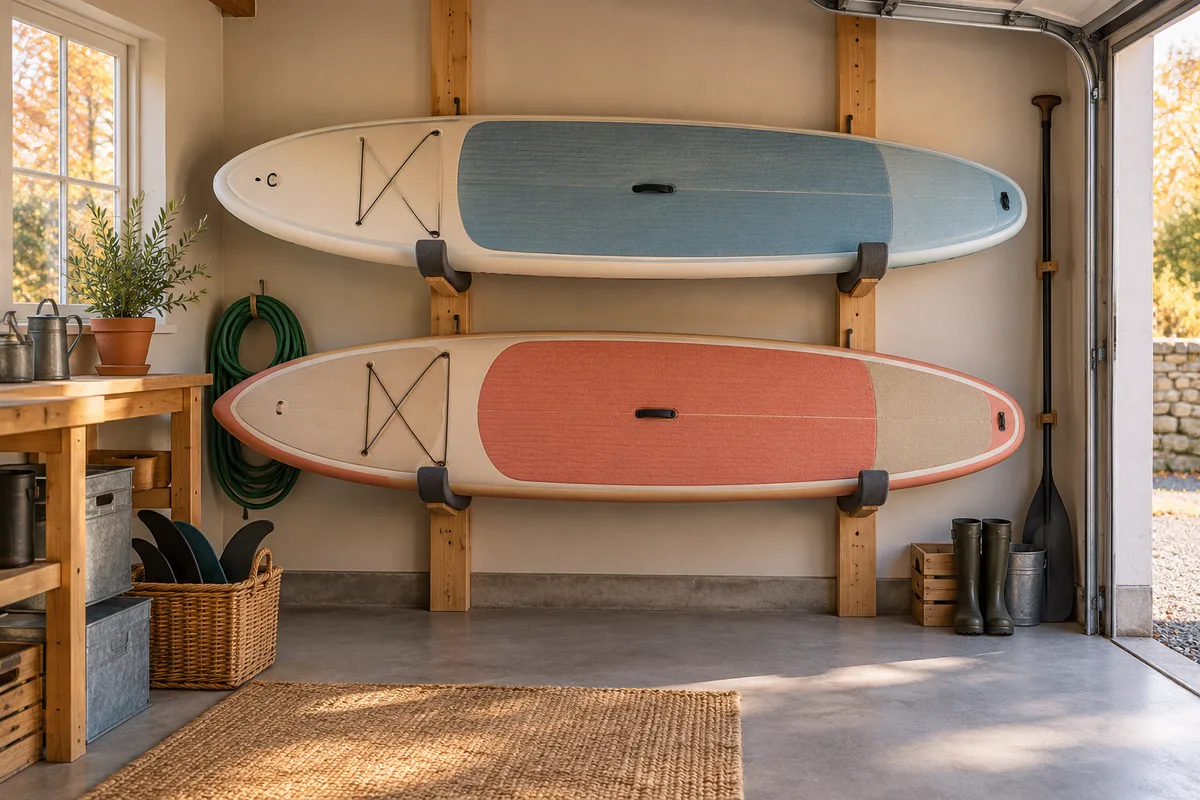
Assess damp, heat, sunlight, pests and access before choosing a garage, shed or outbuilding for a SUP. Check the instructions for your exact SUP model; guidance differs between makers.
Work through the practical choices
Inspect the building for leaks, condensation, standing water and direct sun through windows or clear panels. A shed can change from cold and damp to hot in sun. Check your board’s own manual for temperature, pressure and storage state; do not invent a universal range. Keep boards away from heaters, hot pipes, sharp tools and chemicals.
Use a suitable support that matches the board and keeps it away from falling bikes, timber or tools. An inflatable may be packed or left inflated only as its maker permits. Thurso suggests protecting equipment stored in sheds from animals; any container must be used with a dry board and must not compress it or trap condensation. Leave room for periodic inspection.
Related guides: start with the storage chooser, inflatable board care, garage storage.
Plan around everything that moves
Open the garage door, move bikes and tools through their usual paths and check the space around the board. Include access to sockets, meters and stopcocks. A storage location should work while the room is being used, not only when it is empty for measuring.
For a shed, check the condition of the roof and floor before moving kit in. Inspect the planned location periodically rather than assuming the whole room has the same conditions. If the storage environment falls outside your board maker’s guidance, find another space rather than trying to solve the problem with a bag alone.
Sources & further reading
Manufacturer guidance checked 2026-10-25. Check the instructions for your exact board and model before acting.