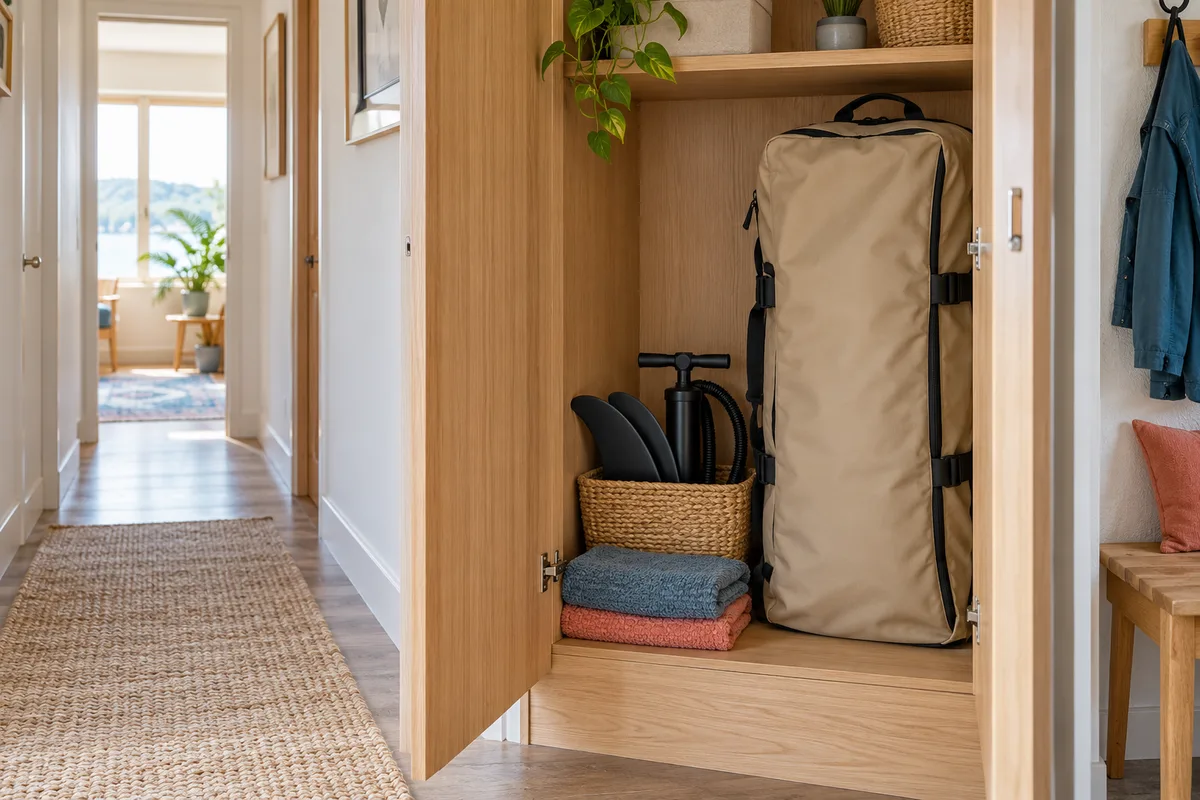
Choose a SUP bag around packed size, board compatibility, carrying route, drying and accessory compartments. Red’s ATB bag page provides model-specific compatibility and compartment information; do not assume it fits other models or brands.
Work through the practical choices
Measure the board in the packed shape required by its maker, then compare with the bag’s stated dimensions and compatible models. Consider stairs, a walk from parking, car-boot access and where the bag will be set down. Backpack straps may help on foot; wheels may suit a flatter route. Features vary by bag, so verify them on its product information.
Check where paddle, pump, fin and small parts fit, and whether the bag separates wet items. Clean and dry the board before packing. Red advises rinsing the bag and kit and drying fully before storage. After transport, open the bag and air it if damp. A bag protects equipment but does not replace model-specific folding and storage directions.
Related guides: start with the storage chooser, inflatable board care, garage storage.
Pack the actual kit before measuring the cupboard
A bag must accommodate your board’s permitted roll or fold, not force it into a smaller shape. Check whether the pump, detachable fins and paddle sections have their own protected space. A tight zipper or a strap pushing into a fin box is a reason to repack or ask the maker about a different bag.
Measure the packed bag at its widest points, including handles and wheels. Check the cupboard opening as well as the shelf depth. Choose how you will lift it before deciding that a high shelf is a practical daily storage position.
Browse available options
Advertising: we may earn from qualifying purchases. These search results are not a compatibility check or a tested shortlist. Check the exact maker, dimensions and instructions before ordering.
Sources & further reading
Manufacturer guidance checked 2026-10-25. Check the instructions for your exact board and model before acting.